With over a decade of dedicated practice in crop cultivation, our team has evolved from a sole reliance on chemical fertilizers to a scientifically optimized combined application of chemical and organic fertilizers. Through long-term field trials and practical exploration, we have accumulated systematic experience in the effects of different fertilizer types on crop growth and soil health. Today, we are pleased to share these insights, aiming to provide a feasible reference for the industry's pursuit of high-yield, high-quality, and sustainable agricultural development.
1. Chemical Fertilizers: Immediate Yield Improvement with Hidden Long-Term Risks
In the early stage of cultivation, like many practitioners in the industry, our team prioritized chemical fertilizers for their efficient and targeted nutrient supply characteristics. Chemical fertilizers can quickly meet the key nutrient demands of crops in specific growth periods: nitrogen fertilizer promotes robust seedling growth of grain crops such as corn, while potassium fertilizer accelerates uniform expansion of fruit crops such as tomatoes. This characteristic ensures a stable early yield and has become an indispensable part of modern intensive agriculture.
However, continuous single-use of chemical fertilizers for 3–4 years exposed a series of problems. Soil compaction became increasingly serious, leading to poor water retention in rainy seasons and easy cracking in dry seasons, which directly affected the development of crop root systems, resulting in lodging and premature senescence in the later growth stage. At the same time, continuous cropping obstacles gradually emerged—pest and disease incidence increased significantly, and crop yields showed a downward trend. In addition, the quality of agricultural products was also affected, with the flavor and taste of fruits and vegetables obviously reduced. It is not difficult to see that chemical fertilizers, as a "quick-acting nutrient supplement", can solve short-term yield problems, but they cannot maintain the long-term fertility of the soil.
2. Organic Fertilizers: Soil-Nourishing Core with Raw Material-Dependent Effects
To address the drawbacks of single chemical fertilizer application, our team began to introduce organic fertilizers into the cultivation system and conducted comparative trials on multiple types of organic fertilizers. The core advantage of organic fertilizers lies in their soil-improving effect—they can effectively loosen compacted soil, enhance soil air permeability and water retention capacity, promote the growth of crop root systems, and improve the overall stress resistance of crops. In practical applications, organic fertilizers have reduced the amount of chemical fertilizers used by 30% while maintaining stable and even increased crop yields, and significantly improved the flavor quality of agricultural products.
However, the application effect of organic fertilizers is closely related to raw material types, and the following practical conclusions have been drawn through trials:
-
Manure-based organic fertilizers: Easy to source and cost-effective, it can initially improve soil structure and promote crop growth. But the product quality is difficult to control uniformly—unfully decomposed manure may cause seedling burning, and the nutrient content varies greatly between batches, leading to unstable application effects.
-
Plant-based organic fertilizers: Fermented from raw materials such as straw and soybean meal, it is mild and safe, without the risk of root burning, and has a significant effect on improving soil compaction. However, its nutrient release rate is slow, and it cannot meet the nutrient demand of crops in the early high-yield stage when used alone.
-
Food by-product-based organic fertilizers: Made from fruit and vegetable processing residues, distiller's grains and other raw materials, it has excellent application performance—significantly increasing the fruit setting rate of crops, improving the uniformity of fruits, enhancing soil fertility, and reducing the frequency of irrigation and fertilization. The only limitation is the relatively high cost, which is a certain burden for large-scale planting operations.
3. Core Conclusion: Synergistic Application of Chemical and Organic Fertilizers for Sustainable Development
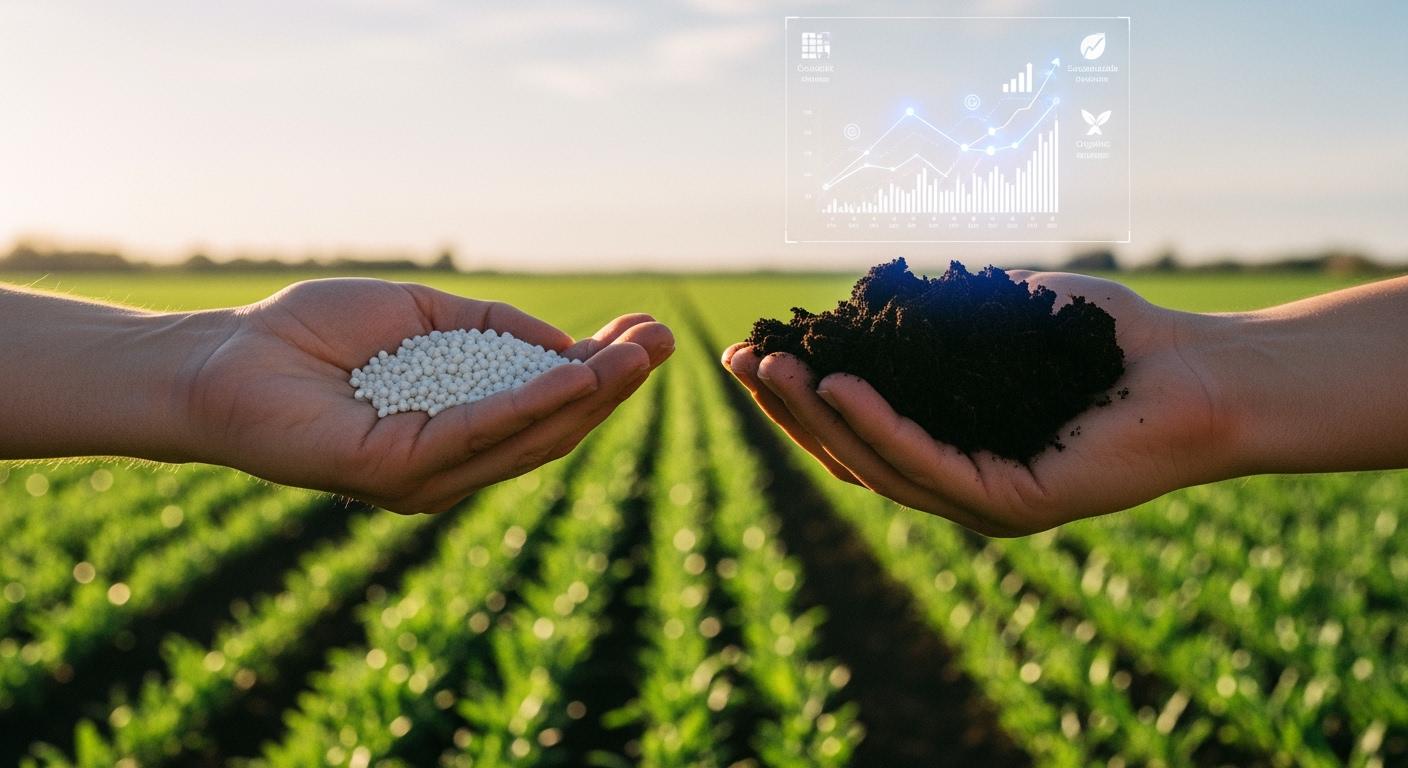
Based on ten years of practical experience, our team believes that chemical fertilizers still play an irreplaceable role in modern agriculture—especially in the critical growth stages of crops, their quick-acting nutrient supply can effectively ensure yield stability. Meanwhile, organic fertilizers are an essential supplement to optimize the cultivation system, which is the key to solving soil degradation and continuous cropping obstacles.
The optimized fertilization scheme formed by our team after long-term practice is as follows: taking organic fertilizers as the base fertilizer, and selecting the appropriate type of organic fertilizer according to the crop type and cost budget—for conventional grain crops, plant-based organic fertilizers mixed with a small amount of fully decomposed manure-based organic fertilizers are preferred; for high-value fruits and vegetables, food by-product-based organic fertilizers are appropriately added to improve product quality. On this basis, chemical fertilizers are used as topdressing, and the dosage is reduced by 30%–40% compared with the traditional scheme, which is only applied in the peak period of crop nutrient demand.
This combined application mode has achieved a win-win situation of soil fertility improvement, stable crop yield and quality upgrading. Although the application of organic fertilizers increases a certain initial cost, the reduction of chemical fertilizer dosage and the decrease of pest and disease incidence have reduced the overall planting cost in the long run.
Agricultural cultivation is a systematic project that requires long-term management. The combination of chemical fertilizers' quick-acting effect and organic fertilizers' long-term nourishing effect is not only a practical exploration of our team, but also a concrete practice of the concept of sustainable agriculture. In the future, we will continue to deepen the research on efficient fertilization schemes and contribute more practical experience to the development of green agriculture.

.png)









.png)




.png)

.png)